Matchsticks in Berlin
A city revisited, a younger self remembered – and one surprisingly difficult search for an ordinary box of matches...

This week, we’re heading to Berlin.
Berlin has meant different things to Rosie Driffill at different stages of her life: freedom and recklessness in her twenties; reflection, political uncertainty and the unmistakable passage of time in the years that followed.
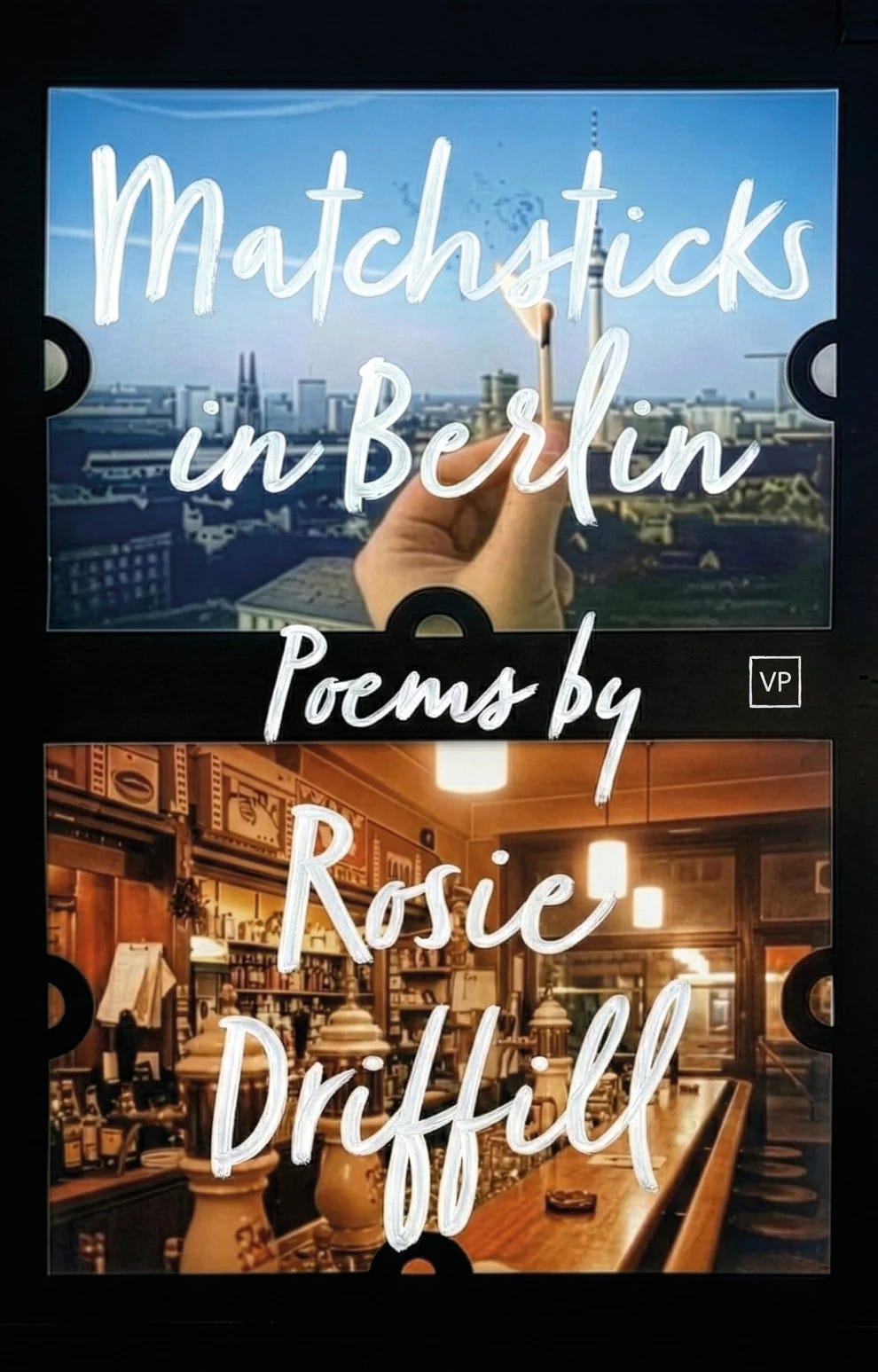
In her new poetry pamphlet, Matchsticks in Berlin, Rosie returns to the city’s museums, boulevards, clubs, cafés and cemeteries – but also to earlier versions of herself. These are poems about travel and memory, illness and ageing, humour and disappointment, and the strange experience of discovering that neither a beloved place nor the person visiting it can ever remain quite the same.
A few months ago, during the final stages of work on the pamphlet, Jamie spoke with Rosie about Berlin, matchsticks, lost youth, German coalition politics – and the locations destined to appear on the future world-famous Rosie Driffill tour…
JM: What did Berlin mean to you at age 20/25/30?
RD: Great question, thank you for asking this. It’ll do me good to capture my thoughts and feelings on Berlin in a more prosaic fashion!
In my early twenties, I suppose Berlin was about desire, indulgence and recklessness. I’d like to say it meant tumbling off the wagon gracelessly but, actually, I recognise that a lot of my youth was about going through the motions of pleasure and recklessness, but not ever fully giving myself over to them. Still, if anywhere could hold a space for a controlled foray into the carefree, it was Berlin.
In a post-Covid world, the city captured my imagination once again, only this time in a more shifting-sands kind of way. For decades, Germany has been known for its consensual politics and commitment to social compromise, and until very recently, coalition governments, proportional representation and government efforts to avert colossal national debts have generally worked well for the country; I held Germany in high esteem for these ideals.
But in recent years, coalitions have been thrown into disarray, and Germany has faced an unprecedented level of strikes and social turmoil off the back of government decisions to impose austerity measures in order to balance the books. I guess I wrote my poems in response to these changes; a country and a city that espoused my own political ideals is shifting.
Does it do us good to cling onto the past, and try to recreate it, both on a social and individual level? Or is growing up about accepting a certain level of change? The poems play on these tensions a lot.
JM: Did travel to Berlin change you, or just reveal changes that happened in between visits?
RD: Definitely the latter. Going back to somewhere familiar does force one to reflect on the passage of time, I think, and what has changed in between visits. I hope there’s a really long German word for that!
JM: Besides the obvious practical example, what does the pamphlet’s titular object – matchsticks – unlock for you, about memory, independence and being in another country?
RD: To me, matchsticks represent basic amenities, basic needs. In a city awash with sex shops and warehouses and museums, I did find it hard sometimes to come by examples of the everyday, on a basic-living kind of level.
Berlin is exciting and captivating, but I craved the mundane as a foil to that. Not being able to find anywhere that sold matchsticks – I mean, I did eventually, but for the sake of artistic licence – made me long for the mundanity and relative ease of home.
It’s the shadow side of adventure, I suppose, and I guess another example of growing older is going into adventures with a more balanced view of them.
JM: To what extent are the depictions of Berlin in the book actual documentary? Are you really describing the city, or are you describing your inner landscape, coincidentally shaped like Berlin?
RD: Both, my friend. But I want to leave it a bit ambiguous as to the extent of each. Readers, even if they haven’t been to Berlin, might find space to identify parts of themselves in the cityscape.
JM: There’s plenty of humour in the collection, but it often sits beside grief, shame, illness or political anxiety. Do jokes help you get closer to difficult material, or do they protect you from it?
Side note: for readers who only know you from your memoir Suddenly, While Living, how are you doing these days?
RD: Another great question. I don’t think I always realise how much humour creeps in until someone points it out. As a psychotherapist, I like to think I’m more congruent than that, but I am also chronically British, and I think most Brits have this hereditary conduit for dealing with difficult topics – and that is humour.
I’m doing better, thank you for asking, but I’m still on my journey with illness, and coming to terms with new limitations. Another big change, and one I never thought I’d have to confront this early in life.
JM: When you’re a world-famous writer, this pamphlet sells a million copies, and they do the ‘Rosie Driffill Tour of Berlin’, what three places will they definitely visit?
RD: Much as that would be wildly lovely, I’m glad I’ll almost certainly never have to contend with this question, because narrowing it down to three is far too hard!
The Neue Nationalgalerie would definitely be number one – it really captivated my imagination as an artistic space. The relevant poem will hopefully map out why.
JM: At what point did the book become expressly political, if you agree it did, and how does it engage with the long, complex past of the city?
RD: I’m not sure I’d describe the collection as expressly political, but it’s an important strand in the work.
I don’t think you can possibly do the city’s complex history justice in one poetry pamphlet, so I chose the aspects of its politics that spoke to me. Comparing a tripartite coalition government trying to run a country to the id, ego and superego vying for control of my – or one’s – personhood was a proud moment. I must have been drunk.
JM: Your Berlin is not romanticised. It ultimately comes across as cold, grubby, absurd, haunted, lonely and disappointing – but with great food and drink! What do you love about Berlin, besides the latter?
RD: I love it because it is all those things… apart from disappointing. I think the disappointment that you’re perceiving is more about my inner child lamenting the notion that things can’t stay the same forever.
JM: Finally, what do you hope people will feel after reading the pamphlet – very possibly in one sitting? What should they reflect on? How is the answer different for someone with their own experiences of Berlin, or someone who has never been, like myself?
RD: If you’ve never been, I’m hoping the collection brings Berlin to life for you.
I suppose, if I really romanticised the spirit of this question, what I’d love is if someone visiting Berlin might like to take the collection with them, and share in a moment with me, or a scene.
On a more universal level, I imagine most readers will be able to relate to themes such as the passage of time, the pain of never being able to reclaim one’s youth, and our tendency to see youth through rose-tinted glasses. But hopefully the backdrop of Berlin is stimulating enough for the collection to be enjoyed on a geographical level, if necessary.
Rosie Driffill is a writer and psychotherapist from North Yorkshire. She has written for the Guardian, Wanderlust, the Dalesman and Therapy Today. Her memoir Suddenly, While Living, a meditation on living with a mysterious, debilitating illness, was published by Valley Press in 2021, followed by her debut poetry pamphlet Blue-Green Algae in 2022. She lives in Calderdale, and splits her free time between the valleys and the moors.